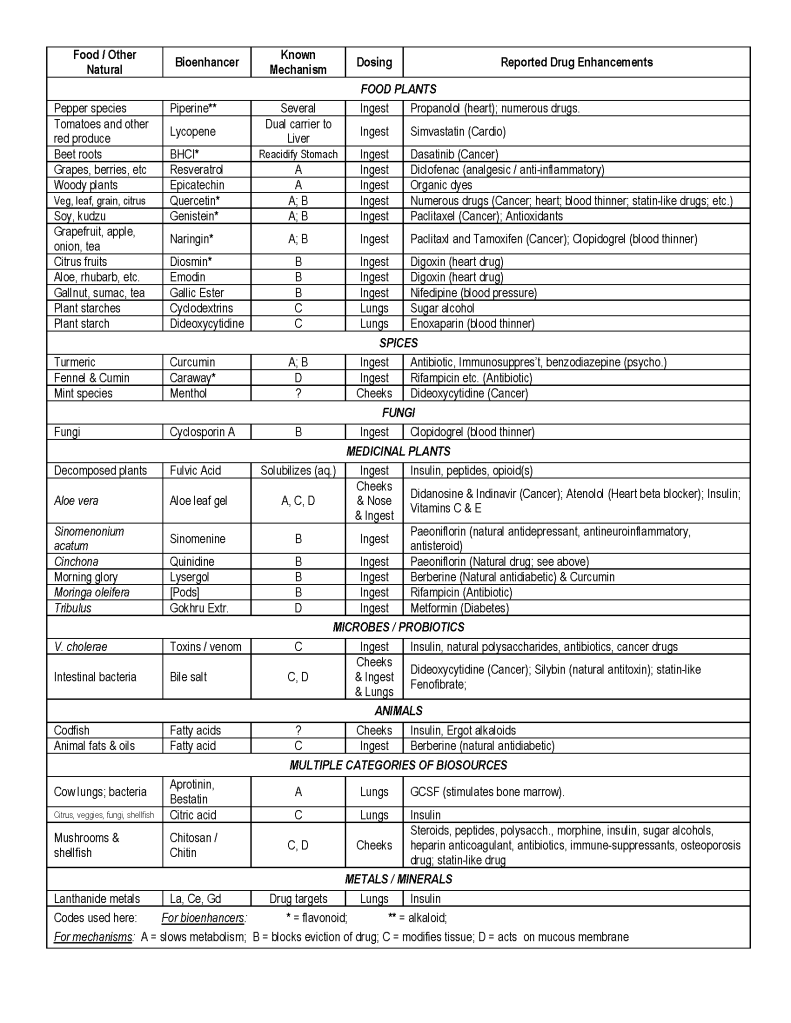
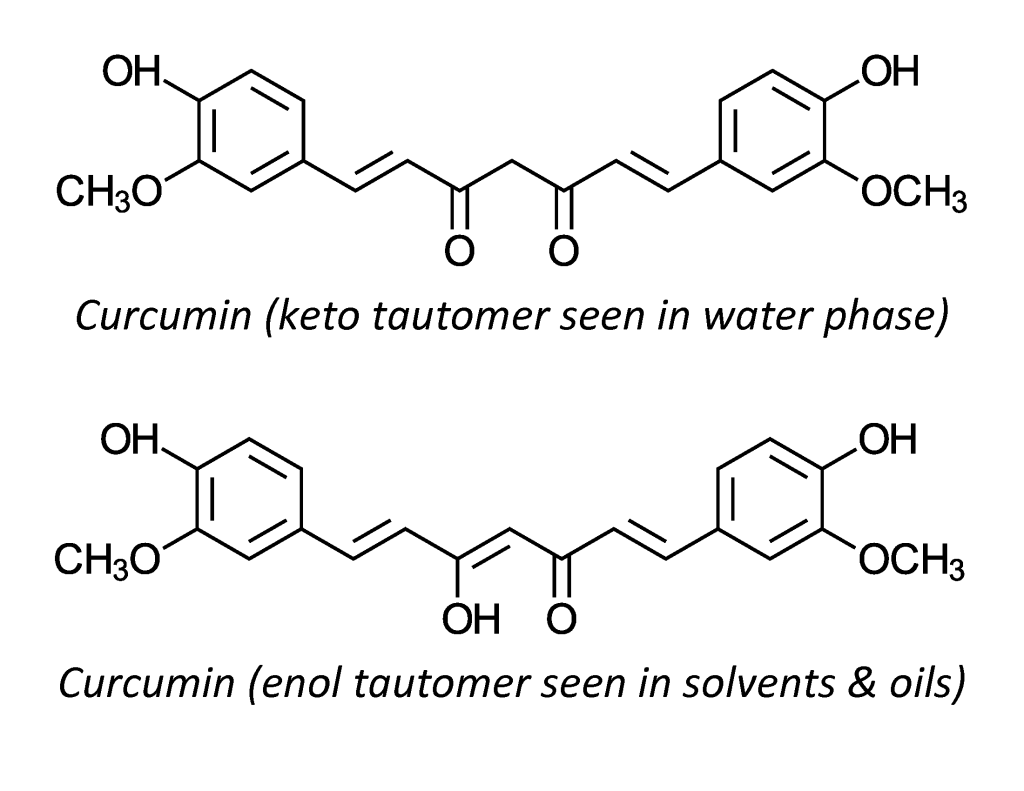
Recently I wrote that the body’s rapid excretion of quercetin leaves far too little time for the clear medical activity detected in test tubes. But it turns out there’s a much deeper irony. Even during its short stay quercetin enhances the bioavailability of other medicinal compounds. The technical term is “bioenhancer” and numerous other compounds in foods do it also, including other barely-bioavailable food compounds such as curcumin. Some of these enhancers have a double disadvantage, for instance, curcumin is not just nearly insoluble but also chemically unstable. Yet somehow these molecules can trigger physiological switches when used to treat patients. I distilled the following table from the Peterson et al. reference below.
Food for Thought
B. Peterson et al., “Drug bioavailability enhancing agents of natural origin (bioenhancers) that modulate drug membrane permeation and pre-systemic metabolism,” Pharmaceutics, 11(1):E33 (2019) (46 p.), abstract and link to free full text posted at https://www.ncbi.nlm.nih.gov/pubmed/30654429 .
S.A. Chavhan, S.A. Shinde, and H.N. Gupta, “Current trends on natural bioenhancers: a review,” International Journal of Pharmacognosy and Chinese Medicine, 2(1):1-13 (2018), posted at https://pdfs.semanticscholar.org/8d6e/8b01b8ccb43dbfef9497667100d076eed3a4.pdf
K. Kesarwani and R. Gupta, “Bioavailability enhancers of herbal origin: an overview,” Asian Pacific Journal of Tropical Biomedicine, 3(4):253-266 (2013), posted at https://www.ncbi.nlm.nih.gov/pmc/articles/PMC3634921/pdf/apjtb-03-04-253.pdf
 Circling-V ™