When I was a kid, there were good drugs for bacterial diseases but you were flat out of luck if you were sick with any kind of virus. A lot has changed since then. Today I hypothesize that even chocolate may have an effect on COVID, by comparison to other known antivirals.
Apart from zinc, the biggest revolution in antivirals has been organic conjugates, meaning molecules with at least two major parts. For antivirals they’re usually: (1) ribose sugar, (2) nucleobase, and maybe (3) phosphate. For the non-chemists out there (bless you for reading this post), you can think of phosphate as being like phosphoric acid in sodas. And you can think of some nucleobases as being like caffeine and the rest as like caffeine’s little brother or sister.
Getting back to conjugates: each one mimics an individual bead in the string of pearls known as RNA (the “other” DNA). Antiviral conjugates (usually) have some unnatural feature in that bead, so when the body inserts them into copies of the viral code, they gum up the genetic factory. Dennis Liotta and others at Emory University in Atlanta, and their collaborators, pioneered much of that. If memory serves, their drugs addressed HIV, HBV, HCV and HDV.
Gilead Pharmaceuticals acquired the rights to those for a cool half-billion dollars; not bad for a university invention. Liotta is interesting – and gracious, if you ever meet him. Most drug research careers are fortunate to have even one success. He has several. And he pioneered intriguing computer modeling of drugs before antivirals hit the big time.
Recently Gilead has been validating a drug called remdesivir, where the RNA bead is doubled in size by molecular additions. The bulk forces a stop in RNA reproduction; it is somewhat delayed. It didn’t work out in hoped-for use against Ebola and Marburg viruses but was found to stop SARS and some other viruses. Remdesivir now has U.S. permission for emergency use against COVID-19. This drug is best administered early in the illness because otherwise the bodily damage is already done, but that will likely be true for all drugs against COVID. Also, remdesivir must be injected.
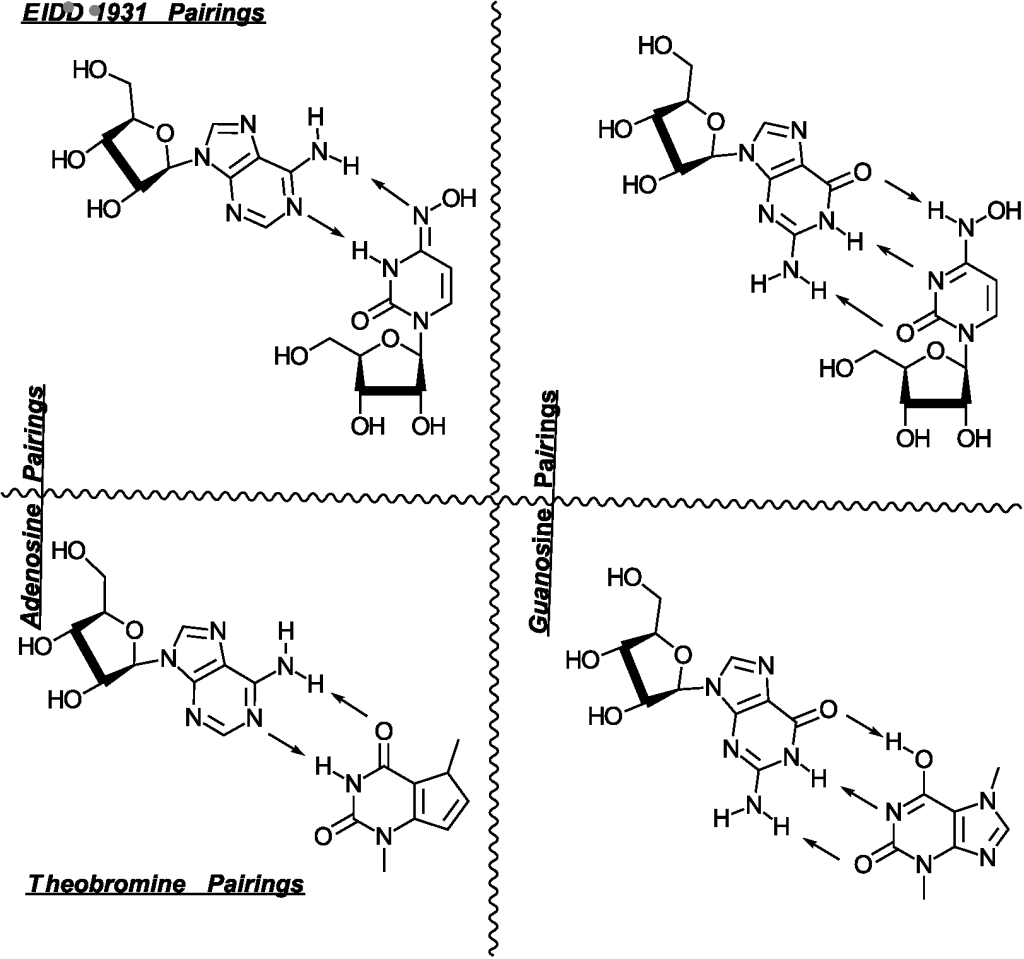
The group at Emory, including George Painter (one of Liotta’s long-time colleagues and a coinventor of his prior successful drugs) is now trying even simpler molecules than remdesivir – much simpler. Which means, elegant. For the nucleobase half of the conjugate, he uses a derivative (an oxime, if you know the term), and leaves off the phosphate. A key feature is how the nucleobase alternates between two different molecular forms, so some of the time the structure complexes in one way with RNA, and some of the time it mates in a different way. In this case, each variation pairs with a different type of opposite nucleobase in long-chain RNA.
The alternate structures are called tautomers. This set causes the body’s RNA-reading enzymes to make a lot of mistakes, leading to a huge number of mutations so the virus can’t function. To enable use in pill form (where the conjugate must pass through the gut wall) the inventors added a minor modification, forming a prodrug named EIDD-2801. Prodrugs get cleaved by enzymes in the bloodstream and revert to the active form. EIDD-2801 (or technically, its active form in the blood, EIDD-1931) works as well against COVID-19 as remdesivir does, AND evades development of drug resistance.
The history is curious, as discussed in the C&EN article cited below. The Russians and Poles tested the same active form 40-plus years ago against smallpox. More recently one of the teams that tests EIDD-2801 for the Emory group (this one is at Vanderbilt) had routinely predicted for years that some kind of coronavirus pandemic is inevitable. And here we are.
Of course, tautomers themselves aren’t new. ALL regular nucleobases in DNA and RNA are tautomeric. And I find online that at least one natural nucleobase variant, isoguanine, is already known to cause mutations in DNA. In fact, the Emory folks contemplated a large number of alternatives: see the patent cited below, but be forewarned that it’s not short. So, I wondered whether nucleobases alone could have antiviral benefits without the rest of the conjugate.
My reading finds that in fact certain free nucleobases (oxypurinol and allopurinol) are known to fight viruses, including flu, colds and cold sores. They act by inhibiting certain enzymes (xanthine oxidase(s)). And those nucleobases are being investigated as combination drugs to address serious complications of COVID-19: acute kidney injury and acute pulmonary injury. It makes me wonder: do oxypurinol and allopurinol have a parallel benefit of triggering mutations in COVID’s genetic replication? Stranger things have happened in drug research.
That brings us to the possibility of natural alternatives. The first choice is caffeine because it is cheap and abundant. Yet its methylation hinders the kind of pairing leveraged by the Emory folks. A better natural option may be theobromine, which acts like caffeine in tea, chocolate, and kola nuts. Both caffeine and theobromine inhibit xanthine oxidase. But to reach the ballpark of virus-effective doses (~40 mg/L) in purinol literature might require a cup of strong tea every two hours (~4 mg/cup). That would hinder sleep and also have diuretic effects.
Fortunately, dark chocolate has much higher concentrations (~1%) of theobromine. Now that sounds feasible. (But milk chocolate has only ~0.1%.) Since a regular-sized dark chocolate bar is ~1.5 oz., its theobromine content falls in the reported effective dose range. We know the body can tolerate a much higher dose (about 10X is the equivalent seen in allopurinol pills for gout etc.); and the body doesn’t get theobromine shakes until 0.8 – 1.5 g/day. So, we can consider consumption approaching one regular dark chocolate bar every 90 minutes.
Every 90 minutes sounds excessive even for a dark-chocaholic like me … ah, heck … let’s run the numbers. One extra-large bar per day (6.8 oz) is like one regular bar every ~4 hours. Working off the calories would require an extra … 7-10 miles of walking or running … per day. Oops. Forget super-sizing this week.
Maybe we can improve on that. Cocoa powder has twice the theobromine by weight and 60% fewer calories. However, it’s bitter, so we’d have to choke it back in pill form. Forget it. Who wants to swallow 63 aspirin-sized cocoa-powder pills to get the theobromine equivalent of a regular-sized dark chocolate bar? I’ll stick with actual chocolate for now.
Now, having said that, nobody really knows whether taking chocolate supplements can help fight off COVID. But I’m willing to try the experiment for the sake of science.
*******
Food for Thought
Bethany Halford, “An emerging antiviral takes aim at COVID-19,” Chem. & Eng. News (5/5/2020).
https://cen.acs.org/pharmaceuticals/drug-development/emerging-antiviral-takes-aim-COVID-19/98/web/2020/05 (open access)
Dennis C. Liotta, George R. Painter, Gregory R. Bluemling, and Abel de la Rosa. (Emory University). “Nucleotide and nucleoside therapeutic compositions and uses related thereto,” U.S. Patent No. 10,149,859 B2 (12/11/2018).
https://patents.google.com/patent/US10149859B2/en
Anonymous, “XORTX launches XRx-101, a new program to treat coronavirus COVID-19 infection” “XRx-101 – a triple action approach to suppressing COVID-19 injury,” Biospace (3/16/2020)
Laurence A. Moran, “Tautomers of adenine, cytosine, guanine, and thymine” (7/17/2007)
https://sandwalk.blogspot.com/2007/07/tautomers-of-adenine-cytosine-guanine.html
 Circling-V ™